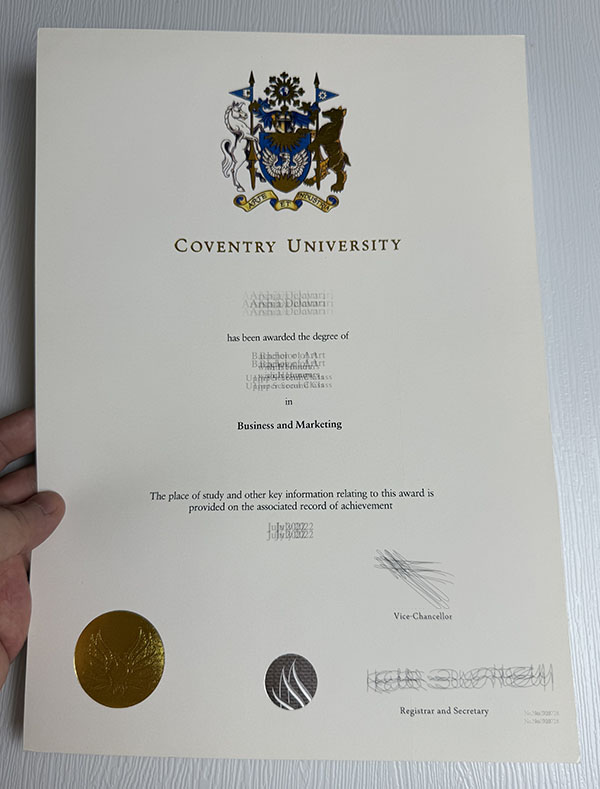
There is a moment in every institution‘s life when it must decide what it wants to become. For Coventry University, that moment came in the ashes. Coventry University diploma, Coventry University degree, Coventry University certificate. In November 1940, the Coventry Blitz destroyed two-thirds of the city’s buildings, including the School of Art that had stood since 1843 and the cathedral that had defined the skyline for centuries. The city rebuilt itself. So did the institution. When you walk through Coventry today—through the Lanchester Library, past the Ellen Terry Building that once housed an Odeon cinema, into the Alison Gingell Building‘s mock hospital wards—you are walking through the physical evidence of a university that has never stopped reinventing itself.
That instinct for reinvention is not incidental. It is the institution’s defining characteristic. Coventry University has been a school of design, a technical institute, a polytechnic, and finally, in 1992, a university. Each transformation responded to a need: the need for skilled workers, the need for technical education, the need for degree-level study in a city that had been underserved by the ancient universities. The phoenix in its logo is not decorative. It is a statement of identity.
Coventry‘s approach to education is shaped by a conviction that has become increasingly rare in British higher education: that a degree should prepare you for something. Not abstractly. Concretely. #Coventry University diploma, #Get a Coventry University degree online.
The university holds a Gold rating in the Teaching Excellence Framework, the highest possible award, and a five-star overall rating from QS Stars. Its graduate employment or further study rate sits at 78 percent. These are not vanity metrics. They reflect a curriculum designed around what employers actually need. The university trains 75 percent of the Midlands’ healthcare professionals. Its Faculty of Engineering, Environment and Computing has produced graduates who lead design at Tesla, model vehicles at Volvo, and engineer software for elite motorsport.
The approach extends beyond individual careers. Coventry University Group has been formally recognised by the Knowledge Exchange Framework for its impact on business and community, exceeding benchmarks in intellectual property commercialisation and public engagement. An economic impact report found that the university‘s city-centre campus generates £320 million in gross value added for Coventry and £1 billion for the UK economy. How fast can i get to buy Coventry University diploma? This is not the language of a university that sees itself as separate from its region. It is the language of an institution that understands its success is inseparable from the success of the place it calls home.
For much of its history, Coventry was known primarily as a teaching institution. That has changed. The Research Excellence Framework 2021 marked a turning point: 70 percent of the university’s research was judged world-leading or internationally excellent, up from 61 percent in 2014. Its submission grew by nearly 200 percent—a deliberate expansion of both breadth and depth that lifted Coventry 22 places in the Times Higher Education research power ranking.
But the quantity of research matters less than its character. Coventry‘s research is distinguished by a commitment to partnership and co-location. Coventry University diploma in UK, Coventry University degree in UK. The Centre for Agroecology, Water and Resilience sits alongside Garden Organic at Ryton Gardens. The Centre for Advanced Low Carbon Propulsion is a joint venture with German automotive consultants FEV, placing researchers and industry engineers in the same purpose-built facility. The university has built formal collaborations with Coventry Cathedral, the National Engineering Laboratory, Severn Trent, and the United Nations. This is not research conducted in isolation and then handed down. It is research conducted at the elbow of the people who will use it.
Where can i get to buy Coventry University degree?
That model has produced work with tangible consequences: a project testing medical drugs to improve early detection of cardiac side effects, community-based rehabilitation for prisoners, transport systems designed for a decarbonised future. The university’s approach to impact acceleration is embedded in its institutional structure, with an annual fund allocating roughly 10 percent of quality-related research income to translating findings into practice.